From Student to First Female Professor: Meet Professor Judith Kamoto, LUANAR’s Newly Inaugurated Professor and Bunda College Director
Posted: October 30, 2026 Posted By: Gift Mkwambisi
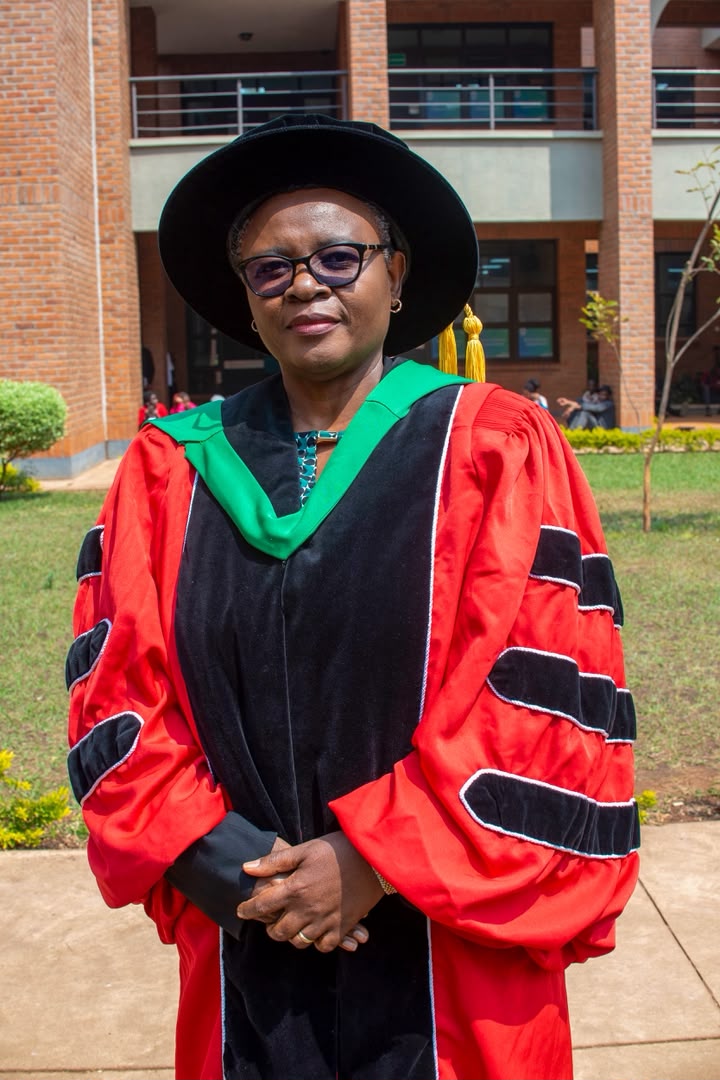
Some journeys come full circle in a way that feels almost too fitting. Professor Judith Francesca Mangani Kamoto began her academic life as a student at Bunda College. Today she leads it, and she is LUANAR’s first female Professor.
Her story starts in 1988, when she joined Bunda College of Agriculture, then part of the University of Malawi. She earned a Diploma in Agriculture in Rural Development in 1992, followed by a Bachelor of Science in Agriculture, specialising in Rural Development, in 1994. Those years shaped a question that would follow her for the rest of her career: how do natural resources shape the lives of the people who depend on them?
After graduating, she joined the Government of Malawi as a Forestry Officer and Lecturer at the Malawi College of Forestry and Wildlife, where she also became the first female Vice Principal. Teaching forestry brought her closer to the practical questions that still drive her work: how forests are managed, whose knowledge informs decisions, who benefits from their use, and what outcomes can actually be observed on the ground.
She then crossed continents for further study. From 1997 to 1999, she pursued a Master of Science in Tropical Forestry, specialising in Social Forestry, at Wageningen Agricultural University in the Netherlands. Her research examined indigenous silvicultural management practices in the miombo woodlands of Malawi. In March 1999, she returned home to join Bunda College as a Lecturer, beginning an academic career at LUANAR that now spans more than 25 years.
Her pursuit of knowledge did not stop there. From 2005 to 2009, she studied at the University of Reading in the United Kingdom, earning a PhD in International and Rural Development (Development Studies). Her doctoral work looked at decentralised forest governance, forest policy and community-based forest management in Malawi, and in particular how forest governance affects rural livelihoods. It deepened her interest in the experiences of the communities expected to put policy into practice.
Back at Bunda, she built a career that brought together teaching, research, student supervision, outreach and leadership. She contributed to the growth of forestry education at the college and served in departmental, faculty and college leadership roles. In April 2024, she was promoted to Full Professor. In August 2025, she was appointed College Director of Bunda College.
Professor Kamoto’s research is wide-ranging. It covers forestry, natural-resource management, rural development, gender, climate-change adaptation, environmental governance, policy analysis and landscape restoration. She has contributed to work on community forestry, sustainable agriculture, climate-smart agriculture, and the management of trees and forests outside protected areas. Her record includes studies on fertilizer trees and climate-smart agriculture in Malawi, and gender-sensitive approaches to agricultural intensification. She has collaborated with international partners including Michigan State University, the International Institute of Tropical Agriculture and the University of Ghana. More recently, she has been involved in research on critical zones, environmental change and the sustainable management of natural resources.
Her inaugural lecture brings these threads together. From village forests to agricultural land, farm trees, household nutrition and woodfuel, it explores how governance shapes people’s opportunities to use and benefit from natural resources. She offers the lecture in appreciation of the communities, colleagues, students and family whose contributions made her journey possible, and to encourage the young women and men who will carry this work forward.
For Professor Kamoto, standing at the institution where she began as a student is an honour she receives with gratitude and a strong sense of responsibility. It is a reminder to every young person who walks the Bunda campus today that the road from student to leader can be a long one, but it can be walked.